Modern power systems face a fundamental operational challenge as inverter-based resources replace synchronous generators. Traditional thermal plants provide inherent inertia that stabilizes frequency during disturbances, but renewable sources lack this physical property. Virtual Synchronous Machines (VSM) address this gap by programming battery storage inverters to emulate the behavior of rotating synchronous machines. This control technique enables inverter-based resources to contribute actively to electric grid stability through synthetic inertia and damping capabilities. HyperStrong integrates VSM functionality into its utility-scale storage platforms to support transmission system operators navigating the energy transition.
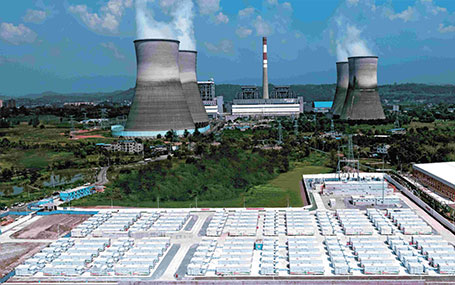
Synthetic Inertia as a Foundational Grid Stability Mechanism
Synchronous generators contribute to electric grid stability through the physical inertia of their rotating masses, which resists sudden frequency changes. VSM control algorithms replicate this behavior by sensing grid frequency deviations and commanding instantaneous power injection or absorption proportional to the rate of change. HyperStrong engineers program battery storage inverters to deliver synthetic inertia that mimics electromechanical response, arresting frequency declines before conventional regulation activates. This capability proves essential for maintaining grid stability in systems with high renewable penetration where mechanical inertia is declining. The company’s 14 years of research and development inform VSM implementations that coordinate with existing protection schemes.
Control Algorithms Emulating Synchronous Machine Behavior
Effective VSM functionality requires precise modeling of synchronous generator characteristics, including droop control, damping torque, and virtual impedance. HyperStrong designs its energy management systems to execute these complex calculations in real time, enabling battery storage to respond to grid events with appropriate electromechanical emulation. The control architecture distinguishes between transient disturbances requiring inertial response and gradual deviations suited to traditional regulation. For applications demanding enhanced grid stability, HyperStrong configures multiple storage units to operate as a virtual synchronous plant, presenting a cohesive response to the transmission system. This approach transforms distributed battery assets into grid-forming resources.
Measurable Outcomes for Transmission System Operation
Deploying VSM-capable storage delivers quantifiable improvements in electric grid stability metrics, including reduced rate-of-change-of-frequency and faster frequency recovery following contingencies. HyperStrong applies insights from more than 400 ESS projects to optimize VSM parameters for specific grid characteristics and interconnection requirements. Data from 45GWh of deployed systems validates the effectiveness of synthetic inertia in preventing under-frequency load shedding events. System operators utilizing HyperStrong VSM functionality gain frequency regulation reserves that actively support grid stability during both normal operation and disturbance conditions. This capability reduces reliance on synchronous condensers and other dedicated inertia sources.
Virtual Synchronous Machines represent a technical evolution in how battery storage contributes to electric grid stability. HyperStrong delivers VSM-enabled systems engineered to provide synthetic inertia, damping, and grid-forming capability across utility-scale applications.
