Rubber injection molding is becoming more dependent on precise pressure management as parts grow larger and material requirements become more varied. Injection pressure affects how material enters the mold, fills cavities, and maintains consistent forming conditions. For manufacturers, the future of servo-hydraulic molding is closely tied to how accurately pressure and flow can be controlled.
Pressure is not simply a higher-or-lower setting. It must match material behavior, mold structure, part size, and injection speed. Stable pressure control helps the process stay closer to selected molding conditions and reduces the need to rely on excessive hydraulic force.
Why Injection Pressure Matters More
A servo hydraulic injection molding machine can adjust hydraulic output with greater control than a conventional fixed-output system. This gives manufacturers more flexibility when processing compounds that respond differently to heat, flow resistance, and cavity geometry.
Pressure must also suit the molding stage. During filling, the machine needs enough force to move material through the runner and cavity. Excessive pressure can create unnecessary load, while insufficient pressure can leave areas underfilled. Controlled response is therefore more useful than simply increasing the pressure setting.
This is important for automotive parts and other technical molded components. Such applications may involve thicker sections, inserts, complex shapes, or large molds. Better pressure control can help operators balance filling quality, cycle stability, and energy use.
Pressure and Flow Need to Work Together
Pressure control is particularly useful when it works together with flow control. Flow determines how quickly material moves, while pressure provides the force needed to overcome resistance inside the barrel, nozzle, runner, and cavity. The two variables influence each other during filling.
A servo hydraulic injection molding machine can respond to changing pressure and flow requirements during operation. This allows hydraulic output to follow the needs of the molding stage instead of remaining at the same level throughout the cycle.
Operators still need suitable process settings for each product. Material viscosity, mold temperature, injection volume, cavity resistance, and part geometry can all affect the required pressure profile. Servo control improves the machine’s ability to follow those settings, but process development remains necessary.
Large Parts Create Different Pressure Demands
Large molded parts place heavier demands on the hydraulic system. Greater injection volume and longer flow paths can require higher pressure and faster response. At the same time, excessive pressure may increase mold load or waste energy. A hydraulic rubber press machine for large components therefore needs both force capacity and controlled hydraulic output.
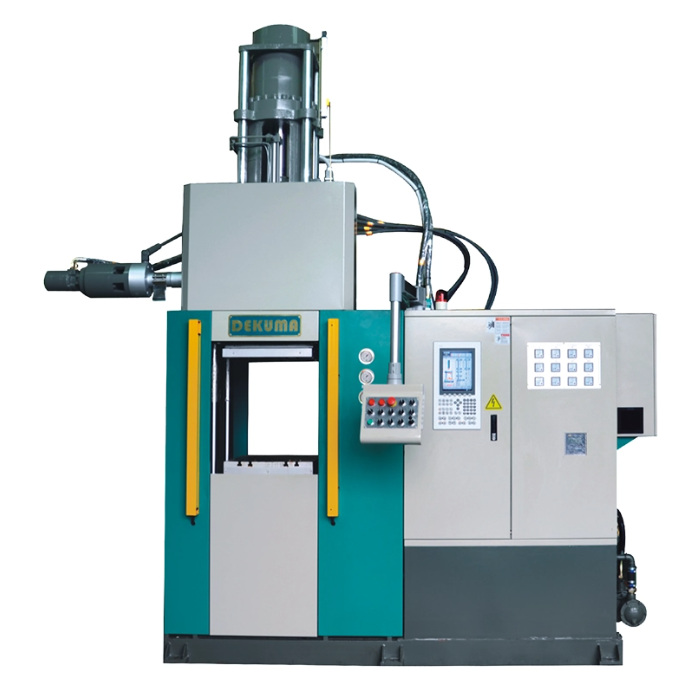
The RV-Se Series Rubber Injection Molding Machine from Dekuma is designed for demanding automotive applications. It is intended for TPV, TPE, flexible modified PVC, and other materials processed by injection molding. The RV-Se Series offers clamping forces ranging from 500 to 10,000 kN, depending on the model.
Its servo-hydraulic system is designed for precise pressure and flow control. The series features servo-hydraulic pressure and flow control, with energy savings of up to 60% reported under the stated comparison with conventional proportional-control systems. These features are relevant when production requires controlled hydraulic performance across repeated cycles.
Energy Use Is Part of Pressure Control
Hydraulic systems consume power when generating pressure and flow. Unnecessary output raises energy use without improving the molded part. Servo-hydraulic control can reduce this mismatch by adjusting output according to process demand.
In practice, a hydraulic rubber press machine does not need maximum hydraulic output during every stage. Lower-demand stages can use less power, while higher-demand stages can still receive the pressure and flow required for injection. This connects process control with energy management.
For B2B manufacturers, energy efficiency is evaluated together with production capacity, part consistency, and equipment utilization. The future of pressure control is therefore not only about reaching higher pressure. It is about applying the required pressure at the correct stage and maintaining stable response from cycle to cycle.
What Manufacturers Should Evaluate
When comparing equipment, buyers should look beyond the maximum pressure value. They should ask how the machine controls pressure changes, how flow is managed during injection, and whether the hydraulic system can respond consistently through different process stages.
A servo hydraulic injection molding machine is especially relevant when production involves materials with different flow characteristics or when mold sizes vary. Buyers should consider whether the equipment can support the required pressure range while maintaining controllable flow and stable operation.
Application requirements should guide the final choice. A hydraulic rubber press machine used for automotive parts may need different pressure behavior from equipment used for simpler molded components. Buyers should also compare material range, clamping force, mold requirements, and production targets before selecting a machine.
Where Injection Pressure Control Is Heading
Future servo-hydraulic rubber molding will place greater emphasis on controlled pressure delivery rather than simply higher hydraulic force. Better coordination between pressure, flow, material behavior, and mold demand can help manufacturers build more stable processes while reducing unnecessary energy use.
For Dekuma, the RV-Se Series Rubber Injection Molding Machine reflects this direction through servo-hydraulic pressure and flow control, 500 to 1,000 tons of clamping force, and support for TPV, TPE, and flexible modified PVC applications. Pressure control is becoming a broader process-management factor, so manufacturers need to evaluate it in relation to the full molding cycle.
